Opinion: Why the Mobile Homes Act is still failing residents on local‐authority sites in 2026
Introduction
Mobile and park homes provide a form of affordable housing for more than 85,000 households in England. Many people living in mobile homes are older or on fixed incomes and rely on them as permanent residences. The legal framework consists mainly of the Mobile Homes Act 1983, as amended by the Mobile Homes Act 2013 and the Mobile Homes (Pitch Fees) Act 2023. Together these laws give residents security of tenure, a regulated annual pitch‑fee review, and greater powers for councils to license and enforce standards on private sites. As the number of mobile homes continues to rise—there were 28,589 Traveller caravans counted in July 2025, a 36 % increase since 2015 —questions remain about whether the legislation is fit for purpose in 2026, particularly for people living on local‑authority sites.
How the Mobile Homes Act protects residents—and where it falls short
What the Act achieves
The 1983 Act gave mobile‑homeowners basic contractual rights, including security of tenure (they can only be evicted by court order), the right to sell or gift their home, a requirement for site owners to maintain services and repair the pitch, and an implied term that pitch fees can only be reviewed annually. These rights were extended to council‑run Gypsy and Traveller sites in 2011 after the European Court of Human Rights ruled that the old licence regime breached Article 8 .
The 2013 Act introduced a new licensing regime. Councils can now charge licence fees, issue compliance notices and carry out emergency works; they can also recover costs from site owners. Reforms such as the fit‑and‑proper‑person test (in force since 2021) aim to ensure site managers are competent and of good character . The Pitch Fees Act 2023 changed the inflation index for pitch‑fee reviews from RPI to the fairer CPI . These measures have improved standards on many private parks and given residents avenues to challenge unfair treatment.
Persistent problems
Despite these improvements, the House of Commons Library notes that many park‑home residents continue to face problems: some site owners exploit procedures or harass residents, awareness of rights remains low and local authorities struggle to enforce the law . In 2018 the government’s own review reported only 47 compliance notices and eight prosecutions nationwide, largely because councils lack resources and legal support. A 2025 parliamentary answer confirmed that the government has no plans to review the Act further, despite ongoing complaints.
The shortcomings are amplified on council‑run Gypsy and Traveller sites. Residents are protected by the same implied terms, but enforcement and redress mechanisms are weak. The Housing Ombudsman and Regulator of Social Housing will not investigate these sites because they are not classed as social housing . Residents must instead take their council to a tribunal, but there is no legal aid for disrepair cases. Consequently, many people endure damp, unsafe amenities and long delays for repairs .
The pitch shortage on local‑authority sites
The twice‑yearly Traveller caravan count offers insight into pitch availability. In July 2025 there were 28,589 Traveller caravans in England, of which 24,125 (84 %) were on authorised sites. Of these, 6,267 caravans (22 %) were on authorised socially rented sites—effectively council‑run pitches —while 17,858 were on private sites. Unauthorised caravans numbered 4,464, indicating a persistent group with no lawful place to stop.
The accompanying live tables show how limited pitch availability is. Across all local‑authority and registered‑provider sites in July 2025, there were 204 vacant residential pitches, 288 occupied transit pitches and 149 vacant transit pitches, with a total caravan capacity of 7,001 pitches. A 2021 Freedom of Information survey of councils by Friends, Families and Travellers (FFT) found only 59 permanent pitches and 42 transit pitches vacant across England and 1,696 households on waiting lists. Shortage of pitches forces families onto unauthorised encampments or into overcrowded conditions.
Cost‑of‑living crisis and energy costs on local‑authority sites
Why energy bills are higher
Mobile homes rely on electric heaters or bottled gas to stay warm; most local‑authority and many private sites are not connected to the gas grid. Residents typically buy electricity from the site owner, who resells energy bought under a commercial tariff. Government guidance says park owners cannot charge more than they pay for energy, but commercial tariffs attract 20 % VAT and no domestic price cap, so even honest site operators pass on higher costs.
A coalition of Gypsy and Traveller organisations wrote to ministers in August 2022 warning of “astronomically high energy costs” for families living in mobile homes. A Leeds needs assessment found that site residents were paying about 42 % more for energy than settled households. They highlighted that many site owners choose the supplier, leaving residents unable to shop around, and that prepayment meters and bottled gas further inflate costs. In winter a single gas cylinder costing £70–£85 may last only five to seven days, amounting to about £400 a month —five times the average gas bill for a brick‑built five‑bedroom house. Research by National Energy Action in 2023 found that 43 % of Gypsy, Traveller, Roma and Nomadic households surveyed received no government energy‑crisis support, 80 % were turning off heating to save money and more than 70 % found energy unaffordable. Many reported borrowing money to pay for fuel.
Access to government support
Government schemes have been poorly tailored to mobile‑home residents. Park‑home households were excluded from the standard Warm Home Discount because they do not have a direct electricity contract. The government instead operates the Park Homes Warm Home Discount Scheme, run by Charis Grants, but residents must apply each year and do not receive automatic payments. The Energy Bills Support Scheme – Alternative Fund (EBSS‑AF) similarly required residents to apply for the £400 payment. Travellers and elderly residents often face digital exclusion and may miss deadlines. As a result, many eligible households received no help.
On council‑run sites, energy supply problems are compounded by weak regulation. A 2024 investigation by Travellers’ Times revealed that Hertfordshire County Council supplied electricity to its ten permanent Traveller sites via unregulated non‑domestic contracts and provided residents with no individual contracts or itemised bills. Some residents had paid tens of thousands of pounds through “smart” meters without being told how charges were calculated. Because the supply is classed as non‑domestic, residents miss out on domestic tariffs and energy price caps. Ofgem does not regulate councils supplying electricity, so there is no effective oversight.
Should residents have a right to buy their pitch?
A radical idea to address insecurity and high costs is to give long‑term residents a right to buy the freehold or long leasehold of their pitch. At present there is no such right under the Mobile Homes Act. Residents pay pitch fees but do not acquire equity; if they leave, they must sell or move the home. Right‑to‑buy schemes exist for council houses and some shared‑ownership properties but have not been extended to mobile homes. Enabling residents to buy their pitch could encourage investment, reduce management costs for councils and empower residents to negotiate utilities and maintenance. However, it could also accelerate privatisation of scarce public sites. Any such scheme would need safeguards to ensure pitches remain affordable and to protect the cultural needs of Gypsy and Traveller families who may wish to retain communal management.
Gypsy and Traveller needs assessments (GTNAs)
Under the Housing and Planning Act 2016, local authorities must assess the accommodation needs of Gypsies and Travellers and identify sites in their local plans. These Gypsy and Traveller Needs Assessments (GTNAs) are supposed to inform pitch targets. Evidence suggests they often underestimate need. A report for Friends, Families and Travellers reviewing GTNAs across the South East found that only 8 of 68 planning authorities were meeting their identified five‑year pitch targets. The 2021 FFT survey mentioned earlier discovered that across 266 local authority and registered‑provider sites there were 4,503 permanent pitches and 354 transit pitches, yet waiting lists totalled 1,696 households. New local plans often allocate few, if any, new pitches, forcing families onto unauthorised encampments. This chronic undersupply is at the root of many tensions.
Conclusion: Legislation that fails the most vulnerable
The Mobile Homes Act and its successors have undoubtedly improved protections for people living in park homes. Residents now enjoy security of tenure, regulated pitch‑fee increases and the ability to challenge unscrupulous site owners. But for people living on local‑authority Gypsy and Traveller sites, the legal framework is not fit for purpose.
- Enforcement and redress: Local authorities rarely use their licensing powers due to cost and lack of expertise; residents on council sites have no access to the Housing Ombudsman and must take their landlord to a tribunal without legal aid.
- Pitch shortages: National counts show a persistent shortfall, with just a few hundred vacant pitches in England and long waiting lists . This drives families onto unauthorised encampments and increases homelessness.
- Cost‑of‑living crisis: Energy costs are disproportionately high because residents pay commercial tariffs, often via unregulated arrangements. Research shows many families pay 42 % more for energy ; some spend £400 per month on gas bottles . Only a minority received any government energy support .
- Exclusion from support schemes: Park‑home residents must apply for separate energy discounts and often miss out .
What needs to change?
- Reclassify council‑run sites as social housing so that residents can access the Housing Ombudsman, Decent Homes Standard and forthcoming “Awaab’s Law” on damp and mould. This would also bring them under stronger consumer protections.
- Restore the statutory duty on councils to provide sites and require them to meet pitch targets identified in GTNAs, with penalties for failure.
- Create a right‑to‑buy or long leasehold option for residents on public sites, with safeguards to prevent loss of affordable pitches.
- Ensure equal access to energy support schemes by making rebates automatic for households without a direct energy contract and by allowing residents to choose their supplier. Ofgem should regulate councils supplying electricity to ensure fair pricing .
- Fund legal aid and advocacy services to help residents challenge disrepair and unfair charges, and support community‑led management models.
Until these reforms are enacted, the Mobile Homes Act will continue to deliver a two‑tier system: one for affluent park‑home residents on well‑run private sites, and another for marginalised families on council sites who are left to cope with overcrowding, high bills and inadequate living conditions.
By Claire Rice BSc MA
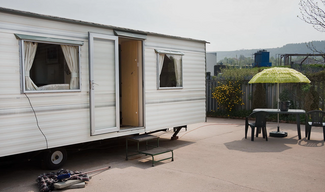
(Photograph: Still from Turning Point video by Percy Dean)