Beyond Recognition: Why the Council of Europe Strategy for Roma and Traveller Inclusion (2026–2030) Matters
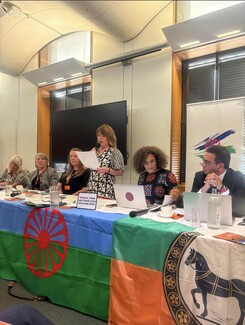
The launch of the Council of Europe Strategy for Roma and Traveller Inclusion (2026–2030) at Westminster was much more than another policy event. It was a clear sign that the exclusion still faced by Romani and Traveller communities remains one of the toughest human rights and social justice issues in Europe. The Strategy aims to boost participation in political life, tackle antigypsyism, ensure equal rights and dignity for all, and help Roma and Traveller people take pride in their identity (Council of Europe, 2026).
For me, the launch held particular significance. Almost a year ago, in my role as Romani and Traveller representative at the International Federation of Social Workers (IFSW), I spoke with the Head of the Roma and Travellers Division at the Council of Europe about how UK parliamentarians could be more effectively engaged on Romani and Traveller issues. From that conversation, the idea of a Westminster launch for the new Inclusion Strategy emerged, and it has now become a reality.
This happened because of genuine teamwork with Friends, Families and Travellers (FFT) and the support of Mary Foy MP, who chairs the All-Party Parliamentary Group for Gypsies, Travellers and Roma. The event showed that real change doesn’t just come from government decisions but from strong relationships, sustained advocacy, and persistence.
Launching the new Council of Europe inclusion strategy is just the first step. The real question is whether it will help move things forward in the UK and lead to real change, not just recognition.
In many respects, Wales provides the strongest foundation in the UK for the Strategy's ambitions. The publication of the Anti-racist Wales Action Plan (ArWAP) in 2022, refreshed in 2024, together with the implementation of the Curriculum for Wales, signalled a deliberate effort to place anti-racism, participation, and cultural recognition at the heart of public policy (Welsh Government, 2022, 2024). The Curriculum for Wales created space for Gypsy, Roma, and Traveller history to become part of the national narrative rather than remain invisible, supporting a broader vision of belonging and representation.
What is particularly distinctive, however, is how Wales is increasingly framing Romani and Traveller communities within a broader rights-based discourse. Welsh Government guidance uses the term “Indigenous Gypsies and Travellers” to refer to Romani Gypsies, Irish Travellers, and other communities with longstanding cultural traditions of nomadism and deep historical connections to Wales (Welsh Government, 2023).
This is not simply a matter of terminology. While not a formal legal designation, such recognition carries important implications. It shifts the conversation from one focused primarily on disadvantage to one concerned with participation, representation, and belonging. It also aligns with the principles of the United Nations Declaration on the Rights of Indigenous Peoples (UNDRIP), particularly those relating to cultural identity, participation in decision-making, protection of heritage, and self-determination (United Nations, 2007).
Building on emerging debates about indigeneity and belonging, I have argued elsewhere that recognizing Romani and Travellers as Indigenous to Wales offers more than symbolic acknowledgment. This recognition could reposition these communities as co-creators of Welsh society, rather than as perpetual subjects of policy intervention (Hulmes, 2025).
A rights-based approach requires a shift in how Romani and Traveller communities are positioned in policymaking. Often, these communities are treated as consultees or recipients of intervention. However, significant recent developments, such as the evolution of ArWAP and the increased emphasis on co-production, have been shaped by Romani and Traveller voices, lived experiences, and leadership. For inclusion to move beyond symbolism, Romani and Traveller citizens must be recognized not only as stakeholders but also as leaders, professionals, scholars, activists, and decision-makers. Recognition without representation risks perpetuating the very inequalities that inclusion strategies aim to address.
Rights-based frameworks matter only if they translate into lived experience. The clearest test of this is accommodation. The Housing (Wales) Act 2014 introduced a statutory duty (Part 3) requiring local authorities to assess Gypsy and Traveller accommodation needs and make provision where unmet need is identified (Welsh Government, 2014). At the time, this was one of the most progressive legislative frameworks for Romani and Traveller accommodation anywhere in the UK. However, legislation alone does not guarantee delivery.
Concerns about implementation are not new. The Senedd Equality and Social Justice Committee's inquiry into the provision of sites for Gypsy, Roma and Travellers identified significant shortcomings in accommodation, site conditions, community engagement, and the failure to meet assessed need (Equality and Social Justice Committee, 2022). Subsequent scrutiny suggests that progress has been uneven. The Public Services Ombudsman for Wales concluded that the Welsh Government had failed to fulfill its leadership role in ensuring that local authorities met their obligations under the Housing (Wales) Act 2014. More recent Senedd research reported that many longstanding concerns remain unresolved (Public Services Ombudsman for Wales, 2024; Senedd Cymru Research, 2025).
Maybe the biggest lesson from Wales is this: rights-based frameworks open the door to change, but rights only matter if they’re put into practice and enforced. That’s why the Council of Europe Strategy is so important; it needs to move us from merely recognising issues to taking action.
England presents a markedly different picture. The inequalities faced by Romani and Traveller communities are well documented, particularly in education, health, housing, and discrimination (Cemlyn et al., 2009; House of Commons Women and Equalities Committee, 2019). The problem is not a lack of evidence; it is a lack of sustained political commitment.
Public attitudes are shaped by political and media narratives. For decades, Romani and Traveller communities have often been portrayed through narratives centered on encampments, enforcement, and conflict, rather than on citizenship, contribution, or rights. These portrayals reinforce antigypsyism, constrain public debate, and hinder the sustainability of ambitious inclusion policies. Media and political rhetoric not only reflect public opinion but also actively shape it.
Research on anti-Gypsy and Traveller racism has shown that subtle and institutionalized forms of prejudice continue to shape professional practice and public discourse (Allen & Hulmes, 2021). This dynamic helps explain why discussions of accommodation, educational inequality, health disparities, and participation are often overshadowed by debates over enforcement. Policy development is not isolated; it is shaped by the prevailing social and political climate.
Arguably, the 2019 Ministerial Working Group strategy on Gypsies, Travellers and Roma was the closest England has come to a coherent national inclusion framework (Ministry of Housing, Communities and Local Government, 2019). It recognized inequalities across education, health, employment, and community relations and appeared to signal a more coordinated approach. For a brief period, there was genuine optimism. Yet much of that momentum dissipated. Without dedicated governance structures, resources, or accountability mechanisms, many of its ambitions were left in the long grass.
The difference with Wales really stands out. Wales has sought to make Romani and Traveller inclusion part of a broader push for anti-racism, participation, and cultural recognition. England, by contrast, still relies on piecemeal policies, usually focused on enforcement and encampments.
This isn’t just a policy issue; it’s about whether there’s the political will to make a difference.
If there’s one thing we’ve learned from the history of Romani and Traveller rights, it’s that real change rarely happens simply because institutions decide to act. It usually happens because communities, advocates, researchers, and allies push for it. Community action can take many forms, engaging in policymaking, gathering evidence, advocating, or even taking legal action when needed. (Curran et al., 2024)
Strategic litigation can also serve as an important mechanism of accountability. In Smith v Secretary of State for the Home Department [2024], the High Court found that elements of the enforcement framework introduced by Part 4 of the Police, Crime, Sentencing and Courts Act 2022 unlawfully discriminated against Romani and Travellers, highlighting the tension between enforcement powers and the ongoing shortage of lawful stopping places (Smith v Secretary of State for the Home Department, 2024). The significance of such cases extends beyond the courtroom. They remind us that rights cannot be separated from the material conditions required to exercise them and that accountability remains central to social progress (Curran et al., 2024). Governments may publish strategies, but communities often provide the momentum that turns aspirations into outcomes.
The Council of Europe inclusion strategy also poses an important challenge for social work. Grounded in human rights and social justice, the profession cannot remain neutral in the face of antigypsyism or structural exclusion. Practitioners must understand the historical and contemporary experiences of Roma, Gypsy, and Traveller communities, recognize cultural strengths, and challenge institutional barriers where they exist. The real test of the Strategy will be whether it helps social work move from recognition to action and from intention to lasting change.
Research on social work engagement with Romani and Traveller communities has highlighted the persistence of subtle, often unrecognized forms of prejudice, including what Allen and Hulmes (2021) describe as aversive racism. These dynamics can undermine trust, reinforce exclusion, and shape professional decision-making in ways that are rarely acknowledged. These findings challenge social workers and allied professionals to move beyond cultural awareness toward anti-racist and anti-oppressive practice that actively confronts institutional forms of antigypsyism (Allen & Hulmes, 2021).
The Council of Europe strategy isn’t just another policy document. It’s a real opportunity for social workers to build on culturally informed, anti-racist, and rights-based practice.
Romani and Traveller communities have spent decades fighting to have their experiences recognized. Now, no one can really argue with the evidence of inequality; the real challenge is ensuring that things actually change.
Wales demonstrates the potential of a rights-based approach grounded in anti-racism, participation, and cultural recognition. Yet the findings of the Senedd inquiry, the subsequent Ombudsman investigation, and more recent parliamentary scrutiny all point to the same conclusion: rights frameworks are meaningful only when accompanied by implementation, enforcement, and accountability (Equality and Social Justice Committee, 2022; Public Services Ombudsman for Wales, 2024; Senedd Cymru Research, 2025).
England teaches us something else. Just recognizing inequality isn’t enough if there’s no real political commitment and we don’t challenge the way politics and the media continue to frame Romani and Traveller communities in deficit and enforcement terms; we won’t see lasting change.
If the new strategy is to succeed, it will not be because it changed rhetoric; it will be because it improved lives. The growing recognition of Romani Gypsies and Travellers as Indigenous communities within Welsh policy offers a glimpse of what that future might look like: a Wales in which communities are not defined primarily by deficit, accommodation needs or enforcement, but are recognised as contributors, leaders and co-creators of the nation's cultural, social and political life (Hulmes, 2025; Welsh Government, 2023).
Reaching that future will take more than strategies alone. We’ll need real implementation, accountability, genuine representation, and the courage to challenge the stories that keep Romani and Traveller communities on the margins.
The launch of the Council of Europe Strategy for Roma and Traveller Inclusion (2026–2030) at Westminster wasn’t just about rolling out a new strategy. It was an invitation to imagine a different future and to start making it a reality.
By Allison Hulmes, Romani and Traveller Representative, IFSW.
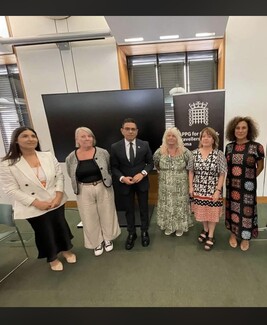
(Photographs courtesy of Allison Hulmes. Caption for lead photograph: L-R - Josie O'Driscoll GATE Herts, Allison Hulmes, Esther Stubbs, Mary Foy MP (Chair of the APPG on Gypsy, Roma and Travellers), Eleni Tsetsekou (Head of the Roma and Traveller division at the Council of Europe), Georgeos Stamatis (Special Rapporteur for Roma and Traveller rights, Council of Europe)
References
Allen, D., & Hulmes, A. (2021). Aversive racism and child protection practice with Gypsy, Roma and Traveller children and families. Seen and Heard, 31(2). Nagalro.
Cemlyn, S., Greenfields, M., Burnett, S., Matthews, Z., & Whitwell, C. (2009). Inequalities experienced by Gypsy and Traveller communities: A review (Research Report No. 12). Equality and Human Rights Commission. ISBN 978-1-84206-088-9
Council of Europe. (2026). Council of Europe strategy for Roma and Traveller inclusion 2026–2030. Council of Europe.
Curran, L., Allen, D. & Feather, J. (2024). Bridging divides to build connections: A scoping review of police practices, behaviours and actions with Roma and Traveller communities. The Police Journal: Theory 98(3). https://doi.org/10.1177/0032258X241309195
Equality and Social Justice Committee. (2022). Provision of sites for Gypsy, Roma and Travellers. Senedd Cymru.
House of Commons Women and Equalities Committee. (2019). Tackling inequalities faced by Gypsy, Roma and Traveller communities (HC 360). House of Commons.
Hulmes, A. (2025). Recognising indigeneity: Advancing human rights and belonging for Gypsies and Travellers in Wales (Manuscript submitted for publication). Child Abuse Review.
Ministry of Housing, Communities and Local Government. (2019). Progress report by the ministerial working group on tackling inequalities experienced by Gypsies, Roma and Travellers. HM Government.
Public Services Ombudsman for Wales. (2024). The investigation of a complaint against Welsh Government (Case 202206003). Public Services Ombudsman for Wales.
Senedd Cymru Research. (2025). A community forgotten: Three years on, but little change for Gypsy and Traveller communities. Welsh Parliament.
Smith v Secretary of State for the Home Department [2024] EWHC 1137 (Admin).
United Nations. (2007). United Nations declaration on the rights of Indigenous peoples. United Nations General Assembly.
Welsh Government. (2014). Housing (Wales) Act 2014. Welsh Government.
Welsh Government. (2022). Anti-racist Wales action plan. Welsh Government.
Welsh Government. (2023). Celebrate and participate: Education guidance to support Gypsy, Roma and Traveller children and young people. Welsh Government.
Welsh Government. (2024). Anti-racist Wales action plan: 2024 update. Welsh Government.
Yuval-Davis, N. (2006). Belonging and the politics of belonging. Patterns of Prejudice, 40(3), 197–214. https://doi.org/10.1080/00313220600769331