The 'illegal camps' crisis is a myth: the real scandal is the denial of homes to Gypsies and Travellers
OPINION: 'Provision not prohibition' - Drive 2 Survives' Sherrie Smith reacts to the recent cranking up of anti-Traveller site rhetoric among politicians and the media
Amid the current political rhetoric about "clampdowns" and "scarring the countryside," a single statistic from the government's own data tells a different story: in July 2024, there were just 813 Traveller caravans on unauthorised encampments on land they did not own in all of England. This is the group typically labelled a blight on communities. To house every one of these caravans would require less than a single square mile of land. The political and media frenzy is not about scale, but about the refusal to grant one of Britain's oldest ethnic minorities the basic right to secure, safe housing.
The official count reveals a more complex picture. Of the 27,429 Traveller caravans in England, the overwhelming majority—85%—are on authorised land with planning permission. The real growth is in private sites; the number of caravans on authorised, privately funded plots surged by 13% in a year. This indicates families desperately investing in creating their own stability, often against immense bureaucratic odds. Conversely, the number on socially rented sites fell by 4%, showing a retreat by the state from its duty to provide accommodation.
The rise in "unauthorised developments"—caravans on land bought by travellers but without planning permission—is not an act of criminality, but a symptom of a blocked system. When waiting lists for a council pitch can exceed a decade, and over two-thirds of local authorities have failed to plan for the sites they are legally required to provide, buying land and applying for permission retrospectively is often the only option left.
The criminalisation of a way of life
The government's response to this housing crisis has been to legislate against the symptom. The Police, Crime, Sentencing and Courts Act 2022 created new offences around "intentional trespass." Campaigners from the outset condemned it as an "existential threat" to nomadic life, arguing it would "wipe out" Gypsy and Traveller culture by criminalising the very act of living in a vehicle without a permanent place to stop.
As Romany activists Sherrie Smith and Jake Bowers warned at the 2021 Drive 2 Survive protest, "If you come for us and you come for our homes and you come for our culture – we are coming for you". The movement, uniting Gypsy, Roma, Traveller and nomadic communities, saw the laws as a form of "cultural cleansing". They argued persuasively that the state was choosing to punish people for having nowhere to go, with one campaigner noting the laws "criminalise a form of homelessness".
Charities like Drive2Survive, Gypsies and Travellers Essex and Friends, Families and Travellers (FFT) have called such approaches "inhumane," pointing out that ample criminal law already exists to tackle genuine anti-social behaviour, and that the focus should be on the "true cause": the severe shortage of authorised sites.

A planning system stacked against equality
The government's published planning policy states an aim to "ensure fair and equal treatment for Travellers" and to "promote more private Traveller site provision". Yet in practice, the system is rigged against them. The most significant barrier is the green belt, where Gypsy or Traveller sites are automatically deemed "inappropriate development".
This policy creates a cruel catch-22. With councils failing to identify land, families buy cheaper plots often on the green belt's edge. Their planning applications are then refused for being on the green belt, leaving them in costly legal limbo. There is a glimmer of potential change, however. The government has proposed easing these strict green belt rules for Gypsy and Traveller sites, particularly where councils cannot demonstrate a five-year supply of land for them. Such as Basildon in Essex that has the highest number of Travellers of any town in the U.K. the government has instructed them to find 235 plots for Travellers, according to need in the next ten years.
This reform, if implemented, would be a critical step toward equity.
The path forward: provision, not prohibition
The solution has been clear to communities and experts for decades: build safe sites. As one speaker from the Drive 2 Survive rally put it, "If you want to solve homelessness provide people with somewhere to live. It’s as simple as that". Even police representatives have historically opposed criminalisation, arguing that more authorised sites are the answer.
The equitable solution requires three actions:
- Reform Planning Barriers: The government must follow through on proposals to ease green belt restrictions for Traveller sites where need is unmet. This would allow families who have bought land a fair chance to build a lifelong home and legacy for their families, security and perhaps improve some of their health, educational and employment outcomes, according to latest census results.
- Enforce Council Duties: Central government must hold local authorities accountable for their legal duty to assess need and identify a five-year supply of deliverable sites. The current widespread failure is a direct cause of unauthorised encampments.
- Invest in Public Sites: The decline in socially rented pitches must be reversed with dedicated funding. Safe, well-managed public sites are essential for those who cannot provide their own.
Gypsy and Traveller communities have been part of Britain for over 500 years. After half a millennium, the demand is not for special treatment, but for equity: the same right to plan a home on land they own that any other citizen takes for granted. The current framework of criminalisation and planning obstruction is not just a policy failure; it is a denial of that fundamental right. The "problem" of unauthorised encampments will persist only as long as the solution—adequate, lawful places to live—is systematically denied.
By Sherrie Smith
Co-Founder of Drive 2 Survive
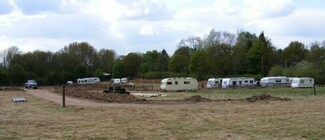
(Lead photograph: The Meriden green belt Traveller site under development. Meriden Traveller site became a news staple in the national and local media for three years around 2010, after local residents and other non-local supporters ganged-up to successfully campaign to get the site evicted © Damian Le Bas)