More Than Just Words: The Small Voices Carrying Scotland’s Hidden Gypsy Traveller History
At Nackens Now and Then, art, archives and family testimony showed why community voices such as Shamus and Roseanna McPhee’s must be seen, heard and properly supported – By Violet Cannon, Proud Gypsy Traveller CIC
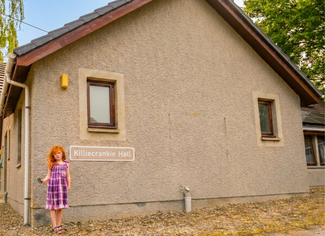
On 26 June 2026, I attended Nackens Now and Then at Killiecrankie Village Hall, near Pitlochry.
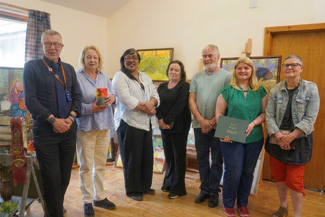
David McPhee, a member of Perth and Kinross Council staff—and, as far as we are aware, no direct relation to Shamus and Roseanna McPhee—opened the event to a standing-room-only audience.
One line from his welcome stayed with me:
“We need more than just words.”
By the end of the day, those words carried even greater weight.
This was not simply an art exhibition. It was a family archive, a historical record, a public education event and an act of resistance.
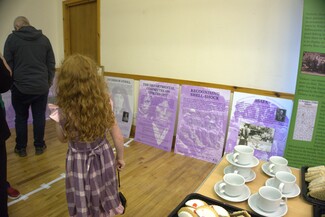
The room was filled with timelines, family photographs, official correspondence, academic research and the bright, vibrant paintings of Scottish Gypsy Traveller artist and activist Shamus McPhee.
Together, they told a history that Scotland has too often ignored.
A history much wider than a few huts
Roseanna McPhee made one point particularly clear:
“The Tinker Experiment was not just a few huts in Perthshire. It was much wider.”
The exhibition showed exactly that.
The timelines traced centuries of legislation and policy affecting Scottish Gypsy Travellers. They moved through early anti-Gypsy laws, the criminalisation of traditional stopping, inquiries into the so-called “Tinker problem”, child removal, forced settlement and the gradual disappearance of traditional employment.
The Tinker Experiment did not suddenly appear in the 1940s. It emerged from centuries of laws, policies and public language that had already taught wider society to view Gypsy Travellers as a problem to be controlled.
Official records used words such as “rehabilitate”, “reclaim” and “integrate”. On the surface, those words can sound almost helpful. In practice, they often meant forced assimilation.
Families were placed in segregated and deliberately substandard accommodation. They were expected to abandon travelling, traditional work, cultural practices and community relationships to prove that they could become acceptable members of settled society.
Research led by Professor Ali Watson OBE and the Third Generation Project at the University of St Andrews found evidence of forced or discriminatory housing policies in 27 of Scotland’s 32 present-day local authority areas.
That challenges the idea that the Tinker Experiment was a small local project involving only one or two settlements.
It was widespread.
The buildings may have differed. Some families were placed in huts, caravans, camps or isolated housing, but Professor Watson described the outcome as often being the same:
“A constant ghetto.”
When welfare becomes control
The exhibition showed how almost every part of family life could become subject to official control.
Employment could be arranged or supervised. Welfare could be made conditional on compliance. Traditional trading could be restricted. Parents could be judged for continuing to travel, while children could be removed or sent to segregated schools.
The language of “child welfare” appeared repeatedly. Yet the welfare of the children did not seem to include their right to remain connected to their parents, extended families, culture or identity.
Shamus and Roseanna shared how their mother, Agnes Johnstone, attended a segregated “Tinkers’ school”. They described children being sprayed with DDT and educated separately from other local children.
Their great-grandmother, Helen Johnstone, née MacDonald, was among the first tenants placed at Bobbin Mill in 1947, although the family had lived in the area long before the huts were built.
Families who had lived traditionally in tents in the surrounding woods were moved onto the settlement and placed in cold, damp and substandard huts.
They were described as a “drain on the welfare state” and a “blight on society”, even though the same systems frequently refused them access to proper welfare, services and support.
They were placed in conditions that made life harder and were then blamed for struggling within them.
Who decides what history survives?
Paula, an archive manager who supported Shamus and Roseanna through RAJPOT in developing a knowledge base, spoke about the importance of communities being able to access their own records.
Her words were simple but powerful:
“People must have access to their own history.”
The exhibition explained that archives are not neutral places where every life and experience is preserved equally.
Somebody decides what is recorded.
Somebody decides what is kept.
Somebody decides whose knowledge is considered legitimate and whose voice is worth preserving.
Scottish Gypsy Travellers were written about by councils, governments, churches, police officers, welfare officials and academics. But they were rarely given the same opportunity to record their own experiences in their own words.
They appeared in official files as problems, cases and statistics—not as families with names, relationships, rights and histories.
Professor Watson spoke about the difficulty of tracing records relating to children who were removed, migrated or adopted overseas.
She asked:
“What is the easiest way of getting rid of someone’s identity? You don’t record it.”
That line hurt my heart.
For those of us still searching for our ancestors and trying to piece together histories that were hidden, those words land heavily.
The gaps in the archives are not simply empty spaces. They represent real people, families and identities that institutions decided were not important enough to preserve.
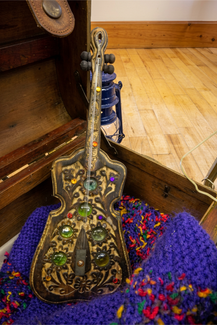
Shamus’s art returns the people to the history
Among the official reports, cold bureaucratic language and painful family records was the colour and life of Shamus McPhee’s artwork.
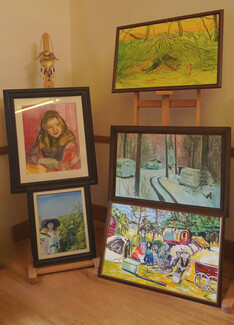
His paintings depict the world he has lived: families, camps, horses, gatherings, landscapes and everyday moments.
They are bright and vibrant, but they do not romanticise Traveller life.
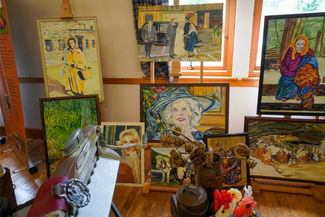
There is warmth in them, but also hardship.
There is humour, but also isolation.
There is family, culture and resilience alongside the evidence of persecution and exclusion.
The official documents showed how institutions viewed the community.
Shamus’s paintings showed the human lives hidden behind those records.
They returned colour, dignity and personality to people who had so often been reduced to a paragraph in a council report or a file marked “Tinker problem”.
That is why Shamus’s art is so important. It is not merely an illustration of the history. It is part of the historical record.
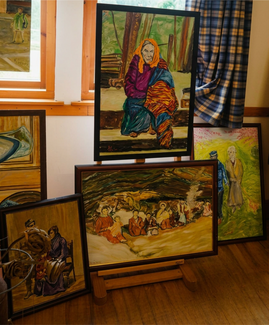
His paintings are testimony.
They show what official archives often fail to capture: the way people stood together, the landscape around a camp, the expressions on their faces and the colour and personality within daily life.
This work deserves to be seen far beyond one community hall. It belongs in galleries, schools, museums and public buildings. It should stand beside the official documents because it tells us something those documents cannot.
The archives show us what was done to people.
Shamus’s artwork shows us who those people were—and who they still are.
Heroes at war, unwanted at home
One part of the exhibition told the stories of Scottish Gypsy Traveller soldiers.
Shamus and Roseanna’s maternal great-grandfather, James “Jimmy” Johnstone, served with the Argyll and Sutherland Highlanders during the First World War.
He fought in terrible conditions, was wounded and hospitalised, and later returned to active service.
Yet when he came home, he belonged to a community that the country he had served continued to treat as inferior and unwanted.
The exhibition also explored shell shock and the experiences of veterans whose trauma was poorly understood and sometimes dismissed as drunkenness, defective character or a failure of self-control.
The contradiction was impossible to ignore.
Gypsy Traveller men were considered British enough to fight and die for the country. Their wives worked on farms, in forests and in munitions factories.
Yet their families could still be segregated, forcibly settled and threatened with the removal of their children.
One title in the exhibition made my eyes smile:
Heroes… Or Raj Hantle?
I did not need anybody to translate those words for me. I was brought up with the terminology.
Raj Hantle means “crazy people”.
Seeing familiar words in an exhibition carrying so much grief, resistance and history gave me a moment of warmth and recognition.
But the title also held a bitter question.
Were these men heroes—or were they the “crazy people” some might consider them to have been for fighting for a country that continued to persecute their families?
To me, there is no question.
They were heroes.
Their families knew it, even when the country they served seemed determined to forget them.
The small voices carrying the biggest histories
Large institutions are now beginning to acknowledge the Tinker Experiment.
There has been academic research, reports and formal apologies.
All of that matters.
But none of it would have happened without smaller voices first refusing to remain silent.
Shamus and Roseanna have spent years gathering documents, preserving family histories, sharing testimony and pushing institutions to confront what happened.
Dr Lynne Tammi-Connelly, Clare McGillivray of Making Rights Real, Ken MacLennan, Colin Turbett and the late Kevin McKay were among those who worked alongside them and other community members to move the campaign forward.
These may be smaller voices in terms of funding, staffing and public reach.
They are not smaller in knowledge, importance or courage.
Too often, larger organisations and institutions arrive after years of unpaid community labour. They produce reports, hold meetings and receive recognition, while the people who carried the history from the beginning continue struggling for resources and visibility.
The lesson from Nackens Now and Then is that we must actively seek out and support the voices that are easiest to overlook.
Not only national organisations.
Not only universities or governments.
We must listen to families, small community groups, artists, elders and individuals who may not have communications teams, professional funding bids or large social-media platforms.
They are often the people carrying the evidence.
“I never knew”
During the exhibition, a man appeared to have wandered into the hall almost by accident.
I assumed he had been out walking and enjoying the beautiful scenery around Killiecrankie.
I am not sure he was ready for what he found inside.
He stood beside me looking visibly shaken as he took in the timelines, documents, photographs and family stories.
In a soft Scottish accent, he repeatedly said:
“I never knew. This is horrible. I never knew any of this.”
I tried to reassure him.
“Not many people do,” I said. “That is why this is so important.”
Then his repetition broke.
He looked at the displays and quietly said:
“My own grandmother was Gypsy. I just never knew this.”
That moment has stayed with me.
He had walked into the hall believing he was learning the history of somebody else. He left realising that it was also part of his own family history.
His grandmother had not suddenly become Gypsy inside that room. She had always been Gypsy.
What changed was that he had finally been given access to a history that helped him understand what that identity might have meant.
That is what erasure does.
It does not only hide a community from the wider public. It separates people from their own ancestors, identity and family stories.
And that is what community-led exhibitions can begin to repair.
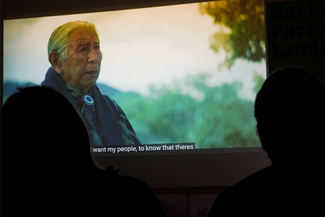
Professor Ali Watson reminded us that the Scottish Government’s apology was only the beginning:
“An apology is just the first step.”
The research found only a small percentage of the evidence likely to remain in archives across Scotland. There is far more still to uncover.
The voices of survivors, descendants and families must sit at the centre of that work.
Community-led archives must be properly funded.
Children must learn this history in school.
People trying to trace lost relatives and identities must be supported.
Artists such as Shamus must be given the platforms they deserve.
At the beginning of the event, David McPhee said:
“We need more than just words.”
He was right.
Shamus and Roseanna have already done the speaking, searching, painting, remembering and campaigning.
The question now is whether Scotland is prepared to listen—and whether the rest of us are prepared to stand beside the smaller voices carrying some of our biggest and most important histories.
Was the Tinker Experiment really the beginning of this history, or simply the point at which it became visible in the records?
At a time when policies and ideas travelled across Britain, were similar programmes of forced settlement, child removal and cultural assimilation also happening in parts of England—but overlooked by historians who did not consider Gypsy and Traveller lives worth recording?
Do you or your family have a story of being forced to settle, moved into segregated accommodation or separated from your traditional way of life?
Please share it with us.
These smaller, rarely heard stories may be the missing pieces of a much bigger history.
Words and photos by Violet Cannon