Claims that planning reforms make it harder to stop Traveller site developments are "wrong" - say Government
The Government has dismissed media claims that its new planning reforms will make it easier for unauthorised Traveller sites to gain approval and harder for councils to stop them, describing the reports as “wrong”.
On Monday (03/08/2026) ministers published their long‑awaited new national planning rules for England, prompting fierce reaction to a small section of the 128‑page document dealing with Traveller site developments. Officials say the interpretation of those changes has been “misinterpreted”, and that councils will retain full powers to act against unauthorised camps.
Among those criticising the proposals was the Conservatives’ Shadow Housing Secretary, James Cleverly, who told The Telegraph that “illegal” Traveller sites were having a “major negative impact” on some areas, leaving residents feeling “abandoned”.
“Police and local councils need our backing to intervene and take robust action without fearing they will be tripped up by activist lawfare,” he said. Cleverly added that a future Conservative government would leave the European Convention on Human Rights to ensure it could force through its proposed policy on unauthorised encampments.
Reform UK also attacked the Government's proposals. “Under a Reform UK Government, we will give police the powers to remove unauthorised encampments immediately, seize vehicles and make arrests, while cracking down on fly‑tipping and ending two‑tier treatment in planning law,” Zia Yusuf, the party’s home affairs spokesperson, said.
Analysis by Travellers Times found significant confusion and disinformation across multiple news reports — including by the BBC. In a report published on Tuesday, the BBC said that data from the bi‑annual government caravan count showed councils reporting 73% more unauthorised Traveller caravans in January 2026 compared with January 2020, rising from 2,860 to 4,950.
However, like many other outlets, the BBC conflated unauthorised developments — camps on land owned by Travellers but without planning permission — with unauthorised encampments on land they do not own, such as verges, laybys and parks. As the controversy centres on changes to planning law, the distinction is crucial.
The factual, relevant statistics are these:
- Unauthorised caravans on land owned by Travellers rose from 2,049 in January 2020 to 4,335 in January 2026, which is a rise of 114%.
- A substantial proportion of these sites are “tolerated” by councils, largely because authorities know the families have nowhere else to go and may otherwise end up on unauthorised encampments on land they do not own.
- Many of these sites awaiting approval will eventually get passed and be removed from the statistics.
- The planning hearing and appeal system, like the criminal and civil courts, is currently suffering from severe backlogs, meaning that sites are building up in the 'unauthorised but on their own land' category, waiting months, but more likely years, for final decisions.
- In January 2026, there where 24,452 caravans on authorised sites (with planning permission), of which 17,973 where on privately developed sites, and 6,479 where on socially rented sites (owned by councils and/or housing associations).
Other media reports also incorrectly described Traveller sites on land owned by Travellers but awaiting planning permission as “illegal”. They are not illegal unless a court injunction has been issued and subsequently breached. Applications for retrospective planning approval are a recognised part of planning law.
A further widespread error was the claim that the Government had “dropped” a requirement for Traveller sites to provide a settled base that reduces long‑distance travelling. This is misleading: such a requirement has never existed in planning law. It was merely a proposal included in the consultation for the new planning framework - and was rejected by the Government in its final response published on Monday.
A Government spokesperson insisted the reforms strengthen enforcement rather than weaken it. “The government is cracking down on illegal traveller sites, and it is completely misleading to suggest otherwise,” an MHCLG spokesperson said - seeming to repeat the common misconception that Traveller site developments on land owned by Travellers but without planning permission are “illegal”.
“Our new planning rules explicitly tackle any potential environmental damage and transport impacts and make it harder for people to get retrospective permission for developments that were built without approval,” the spokesperson added.
The Government, as they have said, have indeed made it more difficult to "intentionally" develop a site and then succeed in gaining planning permission retrospectively, but it will be only one factor considered by council planning officials and government planning inspectors.
However, the changes to retrospective planning applications will apply to all forms of development, not only Traveller sites. Retrospective permission is currently a lawful part of the planning system and is used by private developers and councils alike.
In February 2025, property developer Redsky Homes obtained permission for a five‑storey block containing 41 homes — but built a six‑storey block with 51 homes and then applied for retrospective approval. Permission was ultimately granted following an appeal to the Planning Inspectorate.
And in August this year, Chesterfield Council was forced to apply for retrospective permission for one of its own developments, a move the authority itself described as “embarrassing”.
By Mike Doherty for Travellers Times
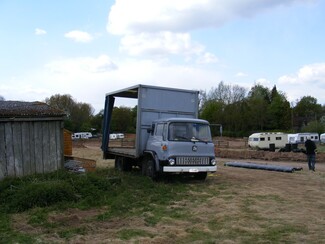
(Photograph: A Traveller site in development © Damian Le Bas)