Massive rise in ‘Gypsy or Traveller’ university students largely driven by Roma – The Travellers Times can reveal

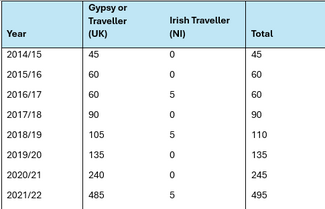
The number of "Gypsy or Traveller" students taking a degree course at university recorded by officials has risen from 105 in 2019/20 to 2,535 in 2023/24 - the Travellers Times investigated to find out more.
The exponential rise in ‘Gypsy or Traveller’ students starting a degree at university is largely driven by Roma students, an investigation by the Travellers Times can reveal.
The Travellers Times has previously reported on the ongoing exponential rise in ‘Gypsy or Traveller’ students starting their first degree at university, which seem to have been doubling and tripling each academic year for a number of years.
We previously reported that in the academic year 2022/23, the number of Gypsy or Traveller students starting their first degree at university in the UK had nearly tripled from the previous year’s number. In 2023/24 the figures nearly doubled again – to 2,535.
This reporting was based on figures published annually by the Office for Students, which, like all government bodies, is required by law to collect and monitor statistics on a number of different demographic groups – including for ethnicity/race, hence the collection of statistics for the number of Gypsy or Traveller students participating in higher education.
But doubts remained among campaigners about both the figures themselves and what was driving this rise, as the education results for Romany Gypsy and Irish Traveller school pupils in the UK remained shockingly lower than the wider population.
After an investigation, which included contacting both the Office for Students and the Higher Education Statistics Agency (HESA), The Travellers times can reveal that the exponential year on year rise is largely driven by Roma students, who were being included in the category ‘Gypsy or Traveller’ alongside Romany Gypsies, Irish and Scottish Travellers and New Travellers and liveaboard boaters.
In a Gypsy and Traveller section on their website, the Office for Students states:
"The term ‘Gypsy, Roma and Traveller’ encompasses a wide range of individuals who may be defined in relation to their ethnicity, heritage, way of life and how they self-identify.
This includes:
- English or Welsh Romany Gypsies
- European Roma
- Irish Travellers
- Scottish Gypsy Travellers
- showpeople such as people linked with fairground or circus professions
- people living on barges or other boats
- people living in settled (bricks and mortar) accommodation
- New Age Travellers.
Recognising this diversity is important to identifying, understanding and addressing the needs of individuals within these communities."
The numbers of students coming from New Traveller and boater backgrounds is thought to be negligible however – at graduate level at least – given the numbers and culture of those cohorts, although further research is needed.
Some campaigners, such as the Traveller Movement charity, argue that New Travellers and Boaters should not be included at all in ethnic data such as that collected by the Office for Students as they are not – as a cohort - legally recognised ethnic minorities unlike Romany Gypsies, Irish and Scottish Travellers and Roma who are legally recognised.
Both Romany Gypsies and European Roma share the same origins in migrations from India during the 10-12th centuries, with the British Romany Gypsies reaching the shores of the British Isles in the 15th Century. Most Roma in the UK are more recent arrivals from countries such as Romania, Poland, Slovakia, the Czech Republic, Lithuania, Latvia, and parts of the former Yugoslavia, having arrived and settled in the UK in the past few decades.
Although Roma people are sometimes grouped together with English Gypsies and Irish Travellers among government authorities and NGO’s, Roma communities often face their own distinct challenges— particularly around potential language barriers, migration, discrimination, and access to support.
The Travellers Times approached both the Office for Students and the Higher Education Statistics Agency (HESA), the organisation which is responsible for collecting data and then passing it on to the Office for Students.
From speaking to the Office for Students, we found out that ‘Gypsy or Traveller’ in their published figures did include Roma who were British citizens and/or living in the UK, but that the Office for Students did not hold the disaggregated data for Gypsy or Traveller and Roma.
However, HESA, who had been collecting the figures for a separate ‘White – Roma’ category alongside ‘Gypsy or Traveller’ since the academic year 2022/23, replied with the disaggregated figures for both groups for that year and the most recent published 2023/24 academic year that the figures are available for.
From the HESA statistics, we can see that in 2022-23, of the 1,560 ‘Gypsy or Traveller’ students that started university in the UK, well over half identified as Roma. In 2023/4, of the 2,535 ‘Gypsy or Traveller’ students, nearly two-thirds identified as Roma.

The Travellers Times asked the Office for Students if they were planning to gather and publish ‘Gypsy or Traveller’ and ‘Roma’ statistics separately in the future.
A spokesperson for the Office for Students said:
“Studies use a range of different classifications for ethnicity and the most commonly used datasets categorise people into between five and 20 ethnic groups.
Across our official statistics, we use groupings of two, five, and 15 ethnic groups. This data can be used by universities and colleges to ensure that all students are able to access, succeed in, and progress from higher education and identify how they might better support different student groups.
Grouping ethnicity data in this way allows us to publish meaningful benchmark statistics for demographic groups that are small in number while reducing the risk of information about individual students being identified.”
However, The Travellers Times understands that the Office for Students is open to reviewing how it categorises and reports the statistics on its Romany Gypsy, Traveller and Roma students.
So – the numbers of Romany Gypsy and Traveller students starting university ARE rising – but not by as much as we previously thought and a large part of the overall rise can be attributed to Roma.
TT News
(Lead Photograph – Stock Photo by Becca Tapert on Unsplash)
ADDITIONAL READING: Download and read the Traveller Movement briefing paper The Importance of accurate ethnic monitoring and data inclusion for Romani (Gypsy) Roma and ethnic Traveller (Irish/Scottish) communities